How Long Can a Flat Roof Leak Go Unrepaired?

It’s the question every homeowner with a new ceiling stain asks: how long can this go before I have to deal with it? A week? Until after monsoon season? Until next year? The honest answer is that there’s no safe waiting period — but that’s not a satisfying answer when you’re trying to plan. So here’s a more useful one: what actually happens inside your roof assembly over days, weeks, and months, and what makes that timeline faster or slower.

The short answer

No two leaks run on the same clock. A pinhole over a well-drained section in a dry month behaves nothing like a failed flashing under ponding water during monsoon season. The variables — breach size, location, roof assembly, drainage, weather — matter more than the calendar.

But one thing is constant: the damage is progressive and one-directional. Water doesn’t undo itself, and insulation doesn’t dry out inside a sealed assembly. Every stage below is worse than the one before it, and each stage costs more to fix. With that in mind, here’s how it typically unfolds.

Days: water gets in and spreads out

In the first days, water entering through the breach moves laterally between the membrane and the insulation, and begins soaking the insulation immediately around the entry point. From inside the house, you may see nothing at all — the water hasn’t reached your ceiling yet. This is the deceptive phase: the roof looks fine, the ceiling looks fine, but the assembly is already wet.

Small, slow leaks can sit in this phase for a while, especially in dry weather. That doesn’t mean they’re harmless — it means the damage is still hidden. A professional assessment at this stage usually finds a localized problem: a failed seam, a flashing gap, a puncture. The repair scope is at its smallest right now.

Weeks: the stain appears

Once water works through the insulation and deck to the ceiling, the first visible evidence shows up — usually a faint discoloration that darkens and grows. If you’ve found one, our guide to water stains on your ceiling walks through what to do next.

By the time a stain is visible, the insulation around the leak path is typically saturated well beyond the stain’s footprint. The repair is usually still a membrane-level fix plus localized insulation replacement — but the affected area is bigger than the stain suggests.

Months: saturation spreads

Given months, water keeps migrating. The saturated zone in the insulation grows outward from the entry point. The deck beneath stays wet — wood begins to soften and rot, metal begins to corrode. Inside, stains spread, paint peels, and the conditions for mold establish themselves in the persistently damp cavity.

This is the phase where the repair scope changes character: from patching a membrane to cutting out and replacing sections of the assembly. Each month of saturation adds square footage to that section. It’s also the phase where waiting starts forcing bigger decisions — the line between repair and replace moves as the damage spreads, which our repair vs. replacement guide explains in detail.

A year or more: structural territory

Leaks that go unrepaired for a year or longer can compromise the deck itself — rotted wood decking, corroded metal, degraded lightweight concrete. Interior damage is usually extensive by this point: ceilings, walls, flooring, and potentially mold remediation across affected areas. At this stage, you’re often looking at partial or full replacement rather than repair.

To be clear: roofs rarely collapse from a single leak. What happens instead is slower and more expensive — the assembly degrades section by section until patching no longer makes sense. Some roofs leak for years before the problem becomes undeniable. The bill grows the entire time.

What speeds the timeline up

Monsoon season

Volume matters. Rio Rancho’s monsoon downpours deliver enormous amounts of water in short bursts. A leak that barely registered in May can saturate a large area in a single August storm — especially if drains are clogged and water ponds over the breach.

Ponding over the breach

A leak under standing water is under constant immersion — water is being pushed into the breach around the clock, not just during rain. The NRCA defines problem ponding as water remaining 48 hours or more after rainfall. If the breach sits in a ponding area, the timeline compresses dramatically.

Clogged drainage

Debris in drains and scuppers turns every rain into a ponding event and keeps water on the roof longer. It’s also one of the easiest accelerants to eliminate — which is why drainage problems show up among the common causes of flat roof leaks.

Thermal cycling working the breach

The high desert’s day-night temperature swings expand and contract the membrane daily. That cycling stresses the breach itself — a small seam separation can grow as the membrane moves around it. The hole gets bigger while the water keeps coming.

Foot traffic and deferred maintenance

Walking on a compromised roof can enlarge the breach. And every maintenance item deferred — an unsealed penetration, a cracked flashing — is another potential entry point joining the first.

What slows it down (but doesn’t stop it)

Rio Rancho’s aridity can make a leak look intermittent: long dry spells let surface evidence dry out, and the stain may not grow for weeks. Don’t mistake a dry spell for a healed roof. Water trapped inside the assembly — between membrane and deck — doesn’t evaporate just because the air outside is dry. The leak is still there; it’s just waiting for the next rain. Intermittent symptoms are still symptoms.

The variables that matter most

If you’re trying to judge your own situation, these are the factors a roofer weighs:

  • Breach size. A pinhole and a torn seam are different problems with different clocks.
  • Location. A breach over a drain behaves better than one in a ponding zone; a breach near the roof’s edge may show inside faster than one in the middle of the field.
  • Assembly. What’s under the membrane — insulation type and thickness, deck material — determines how fast water spreads and how much damage it does.
  • Drainage. Clear drains buy time; clogged drains compress the timeline.
  • Weather. Monsoon season accelerates everything; dry months mask it.
  • Roof condition. A sound membrane with one breach is a different case from a deteriorated membrane with many.

No formula combines these into a safe waiting period — but together, they’re what your assessment will evaluate.

If you must wait: how to limit the damage

Sometimes life intervenes — a contractor’s schedule, a budget gap, a storm in progress. If you can’t get a permanent repair immediately, here’s how to keep a waiting period from becoming a disaster:

  • Protect the interior. Contain drips, move valuables, and keep your distance from any bulging ceiling areas.
  • Keep water moving off the roof. Clear debris from drains, scuppers, and gutters — safely, from a ladder or the edge, not by walking a wet membrane. Every gallon that drains is a gallon that isn’t ponding over the breach.
  • Document the progression. Dated photos of stains and any visible roof issues help your roofer assess how fast things are moving.
  • Don’t try to seal it from inside. Interior caulk and paint don’t stop water entering above — they just hide the evidence while the assembly keeps soaking.
  • Get a professional assessment on the calendar now. Even if the repair has to wait, knowing the scope — and whether temporary professional protection is warranted — turns waiting into a plan instead of a gamble. Contact us to schedule a roof assessment.

The real cost of waiting

Think of it as scope, not just dollars: a week might mean a patch; months can mean section replacement; a year or more can mean structural work and interior restoration. You won’t find exact prices here — they vary too much to print honestly — but the direction is unambiguous. Every stage of delay converts a smaller, cheaper repair into a larger, more expensive project. Acting early doesn’t just save money; it preserves your options, including middle-ground solutions like restoration that disappear once the assembly is saturated.

The bottom line

How long can a flat roof leak go unrepaired? Technically, until the roof or your patience gives out. Practically, every week you wait trades a smaller problem for a bigger one. The leak won’t wait — but you control how much damage it does by how quickly you respond. Get it assessed, get it scoped, and get it fixed while the fix is still small.

Water Stains on Your Ceiling? Here’s What to Do

A brownish stain spreading across your ceiling has a way of stopping you mid-step. It’s not dramatic like a burst pipe — just a discolored patch, maybe with a darker ring around the edge. But that stain is your roof talking to you, and it’s worth listening. This guide covers what a ceiling water stain means, how to tell whether the leak is still active, what to do right now, and what not to do.

What a ceiling water stain actually is

A water stain is the footprint water leaves behind. As water moves through drywall or plaster and then evaporates, it carries dissolved minerals and deposits them in the material — that’s the yellow-brown discoloration. The darker ring at the edge marks how far the water spread before it dried. In other words, the stain is a history of the leak: every wetting and drying cycle adds another ring, and the stain grows a little each time.

On a flat roof home, there’s an important corollary: the stain tells you where water came down, not where it got in. Water that breaches a flat roof membrane can travel sideways across the deck and through insulation before finding a path into your ceiling — so the breach in the roof may be several feet from the stain, or more. That’s why a flat roof leak can’t wait: by the time you see the stain, water has already been moving through the assembly.

First question: is the leak active right now?

Before you do anything else, figure out whether water is still coming in. An active leak needs urgent attention; a dry, old stain still needs investigation, but the timeline is different.

Signs the leak is active

  • The stain feels damp to the touch, or the drywall feels soft.
  • The stain grows visibly during or after rain.
  • Paint is bubbling or peeling in the stained area.
  • You can see dripping, or the ceiling is sagging or bulging.
  • There’s a musty odor near the stain.

Signs the stain is old and dry

  • The stain is completely dry and hard, with no softness in the drywall.
  • It hasn’t changed size through recent rains.
  • No odor, no bubbling, no new discoloration.

A dry stain doesn’t mean there was never a problem — or that the problem is gone for good. A leak can stop temporarily and return with the next big storm. Treat a dry stain as evidence worth investigating, not as a closed case. And document it either way: dated photos of the stain’s size and appearance are useful for a roofer’s diagnosis and for your records if an insurance claim ever enters the picture.

What to do right now: step by step

1. Protect the area

Move furniture, electronics, and anything water could ruin. Lay a tarp or plastic sheeting under the stain. If the stain is actively dripping, place a bucket or container — with a towel in the bottom to muffle the drip and prevent splashing.

2. Document it

Photograph the stain with something for scale (a coin, a ruler), and note the date. If it changes over days or after rain, photograph it again. This record helps a roofer understand the leak’s behavior and gives you a baseline to judge whether things are getting worse.

3. Check whether the ceiling is holding water

Press gently around the stain — don’t poke through it. If the drywall feels soft or spongy, or the area is visibly bulging downward, water is pooling above the ceiling. Give a bulging area a wide berth: saturated drywall is heavy, and sections can give way. This is a call-a-professional-now situation.

4. Look up — safely

If you can safely see your flat roof (from a window, or a ladder at the edge — not by walking a wet membrane), look for the obvious: debris clogging drains or scuppers, ponding water, displaced flashing. Don’t go up in the rain, don’t walk on a wet flat roof, and don’t try to diagnose the breach yourself. You’re gathering context, not performing the inspection.

5. Don’t paint over it — yet

It’s tempting to make the stain disappear with a coat of paint. Resist. Paint over an active or unresolved leak traps moisture, and the stain will bleed right back through — water stains are notorious for defeating ordinary paint. Repainting is the last step, after the source is fixed and everything is dry. (Stain-blocking primers exist for this job, but they go on dry, repaired drywall — not over an ongoing problem.)

6. Get the source found and fixed

A stain is a symptom. The fix is finding where water is entering the roof and stopping it there — which usually means a professional assessment, since the entry point is rarely above the stain. If the stain is active, growing, or the ceiling is bulging, contact us for a roof assessment — call (505) 578-4300 or reach out online.

Reading the stain: what different patterns suggest

Stains are clues, not diagnoses — but they can tell you something about what you’re dealing with:

Yellow-brown rings

The classic water stain. Concentric rings show repeated wetting and drying — each storm adds a ring. A stain with many rings has been active across multiple rain events.

Dark or black spotting within the stain

This can indicate mold growth in the damp drywall. Don’t scrub or disturb it — disturbing mold releases spores. This needs professional handling, both for the mold and for the moisture feeding it.

Sagging, bubbling, or peeling

Paint bubbles and peeling mean water is pushing from behind. Sagging means the drywall has absorbed significant water and is losing integrity. Both point to an active, substantial leak.

Stains around vents, lights, or fixtures

Water often follows penetrations — vent pipes, electrical boxes, recessed lights — down through the assembly. A stain centered on a fixture suggests water traveling along that penetration, which helps a roofer narrow the search (though the roof entry point can still be far away).

Why the stain is rarely above the leak

This deserves emphasis because it changes what fixing it means. Flat roof assemblies are layered — membrane, insulation, deck, ceiling — and water moves horizontally between those layers before gravity pulls it down. The common causes of flat roof leaks — failed seams, flashing gaps, clogged drainage, punctures — can each sit far from where the stain appears. A roofer tracing your stain will inspect the whole roof systematically, not just the area above the spot. Anyone who offers to patch right above the stain without that wider inspection is guessing.

Flat roofs, ceiling cavities, and why there’s no attic to catch it

Many pitched-roof homes have an attic that catches a leak early — you see damp insulation or daylight before the ceiling stains. Most flat roof assemblies have no such buffer: the ceiling cavity between the deck and your drywall is the battleground, and it’s hidden. Water can saturate insulation and pool on the ceiling’s back side for weeks before the first stain appears. That’s another reason flat roof stains deserve a prompt, professional look: the visible stain is often the tail end of a problem that’s been developing out of sight.

What a professional does about a stain report

When you call about a ceiling stain, a proper assessment covers the membrane surface and seams, flashings at every penetration and curb, drainage components, ponding areas, and the interior water path. The goal is to answer three questions: where is water entering, how far has it traveled through the assembly, and what’s the right scope of repair. Our guide to flat roof repair vs. replacement explains how those answers translate into a repair plan — because sometimes a stain reveals a simple flashing fix, and sometimes it reveals a roof at the end of its service life.

One more thing worth knowing: interior repair comes after the roof is fixed and the assembly is dry. Replacing stained drywall before stopping the leak just creates new stained drywall.

Preventing the next stain

The NRCA recommends roofs be inspected at least twice a year — spring and fall — plus after severe weather. That cadence catches the failed flashing or clogged scupper before it becomes a ceiling stain. Between inspections, keep drains and scuppers clear of leaves and debris, and glance at your ceilings after major storms. Catching a stain when it’s small means catching the leak when it’s small.

Red flags: act fast when you see these

  • A ceiling that’s bulging, sagging, or visibly holding water.
  • Active dripping during rain, especially if it’s increasing.
  • A stain spreading quickly across the ceiling or down walls.
  • Water near electrical fixtures or outlets.
  • A strong musty odor signaling established mold.

Any of these means the situation is beyond watch-and-wait. Protect the area, document what you see, and get a professional assessment promptly.

The bottom line

A water stain is information. It tells you water found a path through your roof assembly — and on a flat roof, that path may have started far from where the stain sits. Don’t panic, don’t paint over it, and don’t assume it can wait. Document it, protect the area, and get the source traced and fixed. Roof first, ceiling second, paint last — in that order, a stain becomes a solved problem instead of a recurring one.

Flat Roof Repair vs. Replacement: How to Decide

Every flat roof eventually reaches a fork in the road: repair what’s there, or tear off and start over. It’s one of the biggest maintenance decisions a homeowner faces, and it’s tempting to look for a simple rule — a certain age, a certain number of leaks — that makes the choice for you. There isn’t one. The right answer depends on the actual condition of your roof: the membrane, what’s underneath it, and how water moves across it.

This guide walks through how roofing professionals evaluate that decision, so you can have an informed conversation instead of guessing. The goal isn’t to talk you into either option — it’s to show you what the evidence looks like for each.

Start with the real question: what’s wrong with the roof?

Repair versus replace is a diagnosis question before it’s a budget question. A proper assessment looks at the full assembly: the membrane’s condition, whether insulation underneath is wet, whether the deck is sound, how drainage performs, and the roof’s age and repair history. Each of those answers pushes the decision in one direction or the other. If a roofer recommends replacement without being able to tell you what’s wrong beneath the surface, that’s a red flag — the recommendation should follow the evidence.

It also helps to understand how damage progresses when a flat roof leak goes unrepaired, because the repair option quietly expires as water spreads through the assembly. Timing matters: the same roof might be a repair candidate in spring and a replacement candidate after a monsoon season of unchecked leaking.

Signs a repair is the right call

The damage is localized

The classic repair scenario: the membrane is generally sound, but there’s a specific problem — a puncture from a fallen branch, a flashing that pulled away from a vent, a single seam that opened. The fix addresses that spot: patch, re-weld, or re-flash. When the rest of the roof is healthy, there’s no reason to replace the whole thing for one bad detail.

The membrane is within its service life and basically sound

A repairable membrane is pliable, well-adhered, and free of widespread cracking, crazing, or shrinkage. Surface weathering is normal; systemic breakdown is not. If the membrane still has life in it and the problems are isolated, targeted repairs are the sensible, economical choice.

The assembly underneath is dry

This is the critical test. Repairs make sense when the insulation and deck beneath the membrane are dry and sound. A professional assessment — visual inspection, probing suspect areas, and checking for the telltale signs of trapped moisture — should confirm this. Dry underneath means the repair actually solves the problem rather than covering it.

Drainage works

Water needs a way off the roof. If drains and scuppers are clear and water doesn’t linger — the National Roofing Contractors Association (NRCA) defines problem ponding as water remaining 48 hours or more after rainfall — then the roof’s design is doing its job and repairs can last.

Signs pointing toward replacement

Widespread membrane deterioration

When the membrane itself is failing across large areas — extensive cracking or alligatoring, shrinkage pulling at flashings, brittleness, tenting and bridging at details — patching becomes whack-a-mole. New repairs don’t adhere well to a deteriorated surface, and each fix is surrounded by membrane that’s ready to fail next. Replacement addresses the actual problem: the waterproofing layer is done.

Wet insulation over large areas

Saturated insulation can’t be dried in place — it has to be removed and replaced. When moisture has spread through much of the assembly, you’re effectively rebuilding the roof system anyway; at that point, full replacement is usually more practical than trying to salvage sections. This is one of the main ways an unaddressed leak forces the decision: delay converts repairable roofs into replacement roofs.

Deck damage beyond isolated spots

Rotted wood, corroded metal, or degraded concrete decking means the structure itself needs work. Once you’re opening up the roof to replace decking across significant areas, replacing the membrane system at the same time is the logical move — you don’t put an old roof back over a new deck.

Chronic ponding that can’t be corrected

Some ponding is a maintenance issue — clogged drains, debris in scuppers. But ponding caused by the roof’s structure itself (sagging areas, inadequate slope) won’t be fixed by patching. If water can’t be given a reliable path off the roof, any membrane will live a hard life. Correcting slope usually means work at the replacement level.

You’re repairing the same roof over and over

There’s no formula for too many repairs, but the pattern matters. If leaks keep appearing in new places, patches aren’t lasting, and the repair bills keep coming, the roof is telling you something. Several years of repeat repairs often approach the cost of doing the job once, properly.

The honest middle ground: restoration

Between patch it and replace it sits a third option many homeowners never hear about: restoration. If the membrane is aging but fundamentally sound — dry underneath, no structural issues, drainage working — a restorative system can add years of service without a tear-off. The process typically involves cleaning the roof, repairing seams and details, and applying a reflective roof coating system that seals and protects the existing membrane.

There’s a real energy angle here, too. The U.S. Department of Energy notes that cool roofs reflect more sunlight and absorb less solar energy than conventional roofs — and low-slope roofs are among the best candidates for reflective coatings. In a climate with intense sun, that reflectivity is a genuine benefit, not just marketing.

Another middle-ground option on suitable roofs is spray foam roofing, which can be applied over an existing sound roof to create a seamless, insulating layer. Like coatings, though, these options require a dry, sound substrate — they’re for roofs that are aging, not roofs that are already saturated or structurally compromised. An assessment determines which camp your roof is in.

What you’re deciding about: the membrane matters

The type of membrane on your roof shapes the decision. TPO and PVC single-ply membranes have heat-welded seams that can often be re-welded or patched when the surrounding material is healthy. EPDM, a durable synthetic rubber membrane, repairs differently — with primers and tapes or new membrane sections. Knowing what’s up there (and how old it is) helps your roofer recommend repairs that are compatible with the existing system rather than fighting it.

As for how long each type lasts: it varies with installation quality, maintenance, drainage, and climate exposure. Be skeptical of anyone who quotes you a lifespan without looking at your roof. The honest answer is that an assessment of your specific roof determines how much service life remains.

Questions to ask your roofer

You don’t need to become a roofing expert, but these questions will tell you whether the recommendation you’re hearing is grounded in evidence:

  • Is the insulation wet, and how widespread is it? This single answer drives much of the decision.
  • What’s the condition of the deck? Sound decking keeps replacement optional; damaged decking pushes toward it.
  • Is the membrane repairable, or is it deteriorating overall? Ask them to show you — photos of the membrane condition are reasonable to expect.
  • What’s causing the ponding, if any? Maintenance issue or structural issue? The answer changes everything.
  • What are my options — repair, restore, replace — and what does each one actually solve? You want all three weighed against the same problems.

Understanding the common causes of flat roof leaks beforehand helps you follow the roofer’s diagnosis and check whether the proposed fix addresses the actual cause.

A note on cost (without the fake numbers)

You won’t find prices in this guide, and that’s deliberate: costs vary too much by roof size, access, material, and local labor to print honestly. What we can say is how to think about it. Repairs cost less now but leave an aging roof in place; repeated repairs compound. Replacement costs more now but resets the clock. Restoration sits between the two. Ask for itemized options that describe scope — what’s being removed, replaced, repaired, and coated — and compare scope first, totals second. The cheapest total for the wrong scope is the most expensive mistake.

Rio Rancho timing considerations

Local climate doesn’t change the diagnosis, but it can change the timing. Monsoon season is the stress test: intense downpours find every weakness, and a roof that’s marginal in May can be failing by September. If an assessment says replacement is in your future, planning the work before monsoon season — rather than reacting during it — is simply prudent scheduling. And for roofs that qualify for restoration, a reflective coating going into summer puts the sun to work for you instead of against you.

The bottom line

The goal isn’t the cheapest option today — it’s the lowest total cost of a dry, reliable roof over the years you plan to own the home. Sometimes that’s a well-executed repair. Sometimes it’s restoration. Sometimes the honest answer is replacement. What matters is that the choice follows the evidence: the membrane’s condition, the moisture underneath, the deck, and the drainage. If you’d like that evidence gathered for your roof, contact us for a roof assessment — call (505) 578-4300 or reach out online — and we’ll walk through exactly these questions with you.

Why a Flat Roof Leak Can’t Wait

A water stain on your ceiling or a slow drip during a storm has a way of landing on the to-do list instead of at the top of it. The roof isn’t caving in, the bucket is working, and life is busy. With a flat roof, though, that delay is riskier than it looks. By the time water shows up inside, it has usually been traveling through your roof assembly far longer than you’ve known about it — and every week you wait gives it more territory to damage.

Flat roofs don’t leak like pitched roofs. On a steep slope, water runs downhill and usually appears near the breach. On a low-slope roof, water that gets past the membrane can move sideways across the deck, soak through layers of insulation, and travel along framing before it ever finds a path into your living room. Understanding that difference is the first step toward taking a flat roof leak as seriously as it deserves.

Flat roof leaks hide — and travel

Think of your flat roof as a layered system: membrane on top, then insulation, then the structural deck, then your ceiling. When the membrane is breached — a separated seam, a puncture, a failed flashing — water slips underneath and spreads out. It can migrate several feet from the entry point before gravity finally pulls it through a seam in the deck or a joint in the ceiling below.

This is the single most important thing to know about flat roof leaks: the stain on your ceiling is almost never directly below the hole in your roof. The stain marks where water exited, not where it entered. That simple fact is why patching above the stain so often fails, and why chasing a leak without a real assessment can turn into a frustrating cycle of repairs that don’t hold.

A proper leak assessment works backward — from the interior evidence, across the roof surface, to the actual breach. A roofer checks seams, flashings, penetrations, drains, and ponding areas systematically, because the source is frequently somewhere you’d never guess from inside the house. If you’re weighing whether a leak can wait, start by understanding what it’s doing in the meantime: read how long a flat roof leak can go unrepaired for a realistic picture of how damage progresses over time.

Worker unrolling a waterproof membrane across a flat roof.

What a leak does while you wait

Wet insulation stops insulating

Most flat roof assemblies include rigid insulation boards beneath the membrane, and they’re designed to work dry. Once water saturates them, their thermal resistance drops — and they can’t simply be dried out in place. Trapped between the membrane above and the deck below, wet insulation stays wet, quietly adding weight to the roof while your cooling system works harder to make up for the lost performance.

Saturated insulation has to be cut out and replaced; there is no shortcut. A leak that started as a minor seam repair becomes a remove-and-replace section of the roof assembly once the insulation underneath is soaked. The longer water runs, the larger that section grows.

Decks and structure take the hit next

Below the insulation sits the structural deck — wood, metal, or lightweight concrete. Wood decks rot. Metal decks corrode. Concrete-based decks degrade. None of this happens overnight, but structural repairs mean opening up the roof, replacing decking, and sometimes addressing framing — work that dwarfs the scope of an early membrane repair. This escalation is exactly why the repair-versus-replacement decision matters: the longer a leak runs, the more the answer shifts toward the expensive end of the spectrum.

Moisture invites mold

Dark, enclosed, persistently damp spaces — the inside of a wet roof assembly, a soaked ceiling cavity — are exactly the conditions mold needs to establish itself. You may not see it until stains spread or a musty odor develops, and by then remediation involves more than the roof: affected drywall, insulation, and finishes often have to be removed. Mold remediation is disruptive and costly, and it begins with a moisture problem that was allowed to persist.

Interior damage compounds

Inside the home, water keeps working. Drywall sags and crumbles, paint blisters and peels, wood trim swells, and flooring can buckle. Water reaching ceiling light fixtures or wiring creates safety concerns that go well beyond cosmetics. What begins as a dinner-plate-sized stain can spread across a ceiling and down walls — turning a roofing repair into a roofing-plus-interior-restoration project.

Why a small leak rarely stays small

Leaks have a ratchet effect: they get worse, not better, and each stage of damage is harder to reverse than the last. A separated seam caught early may need only a localized repair. Left alone, water saturates the insulation beneath it, the saturated area spreads, the deck begins to deteriorate, and interior damage follows. At every step, the scope of the fix grows — more material to remove, more to replace, more trades involved.

There is an honest middle path worth knowing about: if the membrane is aging but fundamentally sound, restorative roof coatings can seal and protect it, extending its service life without a full replacement. But coatings are a solution for a dry, sound roof — they can’t fix saturated insulation or a rotted deck. That distinction is precisely what a professional assessment determines, and it’s why waiting until the damage is obvious usually takes the coating option off the table.

Rio Rancho weather doesn’t pause for leaks

Local conditions add urgency. During monsoon season, intense downpours can dump water faster than clogged drains and scuppers can move it, creating ponding — which the National Roofing Contractors Association (NRCA) defines as water that remains on the roof 48 hours or more after rainfall ends. Standing water probes every weak seam and flashing gap, and its weight adds structural stress on top of the moisture damage.

Between storms, the high desert dishes out extreme daily temperature swings. Membranes expand in the afternoon heat and contract at night; that thermal cycling works on seams and flashings like a slow pry bar. Add intense UV exposure that gradually ages and embrittles exposed membrane surfaces, and you have a climate that actively exploits small weaknesses. A minor issue in spring can become a genuine problem by the end of monsoon season — not because anyone did anything wrong, but because the environment never stops testing the roof.

The hidden costs beyond the roof itself

The roof repair is only one line on the bill. Wet insulation forces your air conditioner to work harder through every hot month, so energy costs creep up for as long as the moisture stays trapped. Interior repairs — drywall, paint, trim, flooring — are billed by room, not by leak. And a documented history of water damage can complicate a future home sale, since buyers and inspectors treat chronic moisture as a red flag. None of these costs appear the day the stain shows up; they accumulate quietly while the leak “waits.”

What to do the moment you spot a leak

You don’t need to panic, but you do need a plan. Here’s what helps in the first hours and days:

  • Protect the interior. Move furniture and electronics, lay down tarps or plastic sheeting, and set containers to catch drips. If a ceiling area is bulging with trapped water, give it a wide berth — that’s a sign of significant accumulation.
  • Document everything. Photograph stains, drips, and any visible roof issues. Note when the leak started and what the weather was doing. This record helps a roofer diagnose the problem and helps you if an insurance claim becomes necessary.
  • Don’t make it worse. Avoid walking on the roof more than necessary — foot traffic on a compromised membrane can enlarge the breach. And don’t just caulk over the interior stain; that treats the symptom while water keeps entering above.
  • Trace, don’t guess. Resist the urge to assume the breach sits above the stain. Understanding the common causes of flat roof leaks — failed seams, flashing gaps, clogged drainage, punctures — gives you a better picture of what a roofer will be looking for.
  • Get a professional assessment promptly. A roofer can trace the leak to its source, determine how far water has traveled, and tell you whether you’re looking at a localized repair or something bigger. If you need one, contact us for a leak assessment.

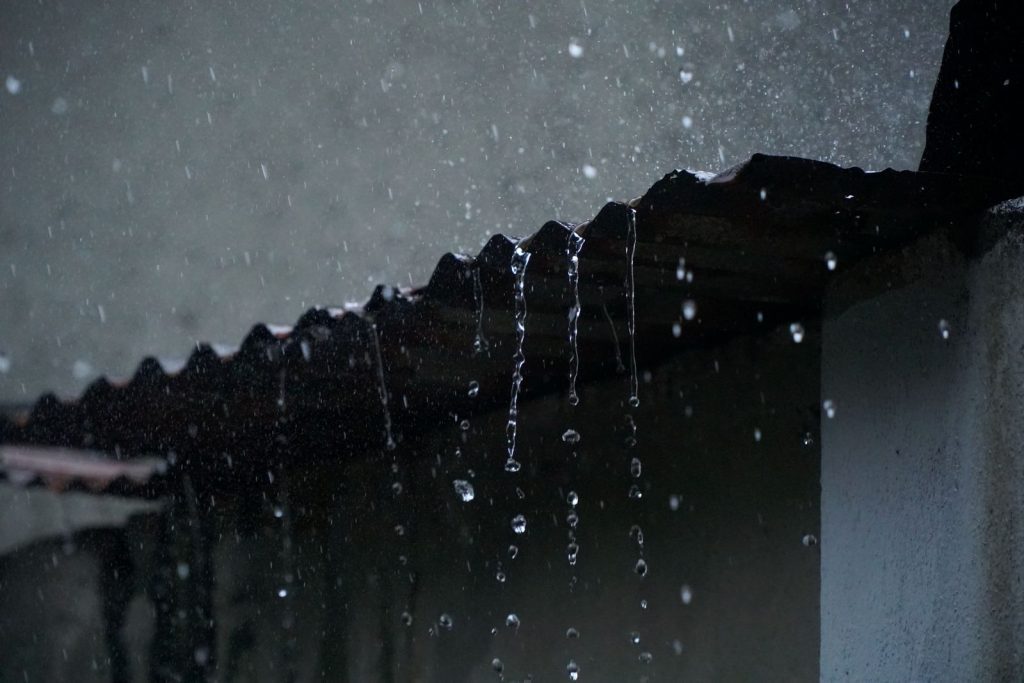
Heavy rain dripping off the edge of a roof during a storm.

What a thorough leak assessment covers

Not all roof inspections are equal. A leak assessment worth paying for is systematic: the membrane surface and all seams, flashings at penetrations, curbs, and parapet walls, drainage components (drains, scuppers, gutters), areas of ponding, and any punctures or mechanical damage. Inside, it traces the visible water path to estimate how far moisture has traveled.

The outcome should be specific: where the water is entering, which materials are affected, and what the repair scope is. Sometimes that scope is a straightforward localized repair. Sometimes the assessment reveals that the leak is a symptom of a membrane at the end of its service life — which is exactly the question our repair vs. replacement guide helps you think through.

The cheapest leak is the one that never happens

The NRCA recommends that building owners have their roofs inspected at least twice a year — in spring and fall — plus after any severe weather. That’s the maintenance cadence that catches separated seams, clogged drains, and flashing gaps while they’re still small. Between inspections, keep drains and scuppers clear of debris and watch for ponding that lingers more than a couple of days after rain.

A flat roof leak can’t wait because water doesn’t wait. It spreads, saturates, rots, and compounds — quietly, out of sight, until the evidence on your ceiling forces the issue. Acting early keeps your options open and the repair as small as it can be. Acting late lets water choose the scope of the project for you.